
1. Introduction
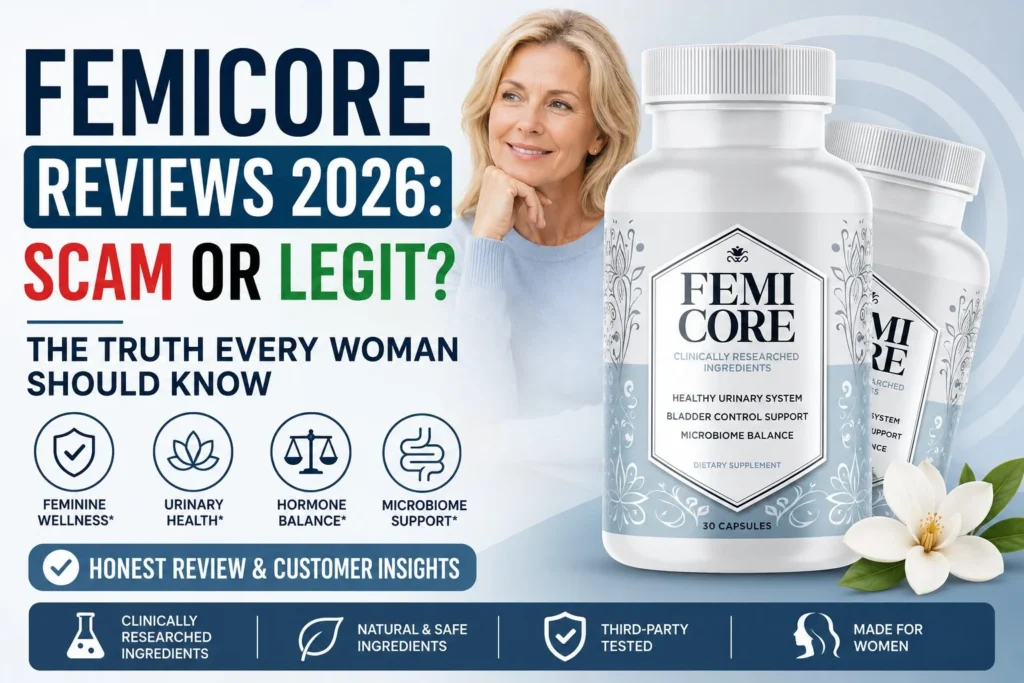
Searches for FemiCore Reviews 2026 have been increasing as more women look for natural options to support hormonal balance, energy, mood, and overall wellness during different life stages. Like many products in the crowded women’s wellness supplement category, FemiCore is marketed with promises of relief from common symptoms many women experience — but marketing language and scientific evidence are not always the same thing.
This review was written to help U.S. consumers evaluate FemiCore critically and responsibly. Rather than repeating manufacturer marketing copy, this article attempts to separate verified facts from unverified claims, and to clearly flag anywhere that current, reliable, independently confirmed information about FemiCore was not available at the time of writing.
Important transparency note: At the time of this review’s research and publication, several specific product details commonly expected in a supplement review — including a fully confirmed ingredient list, exact manufacturer identity, precise dosage instructions, current pricing, and independently verifiable customer reviews — could not be conclusively verified through publicly available, authoritative sources. Where this is the case, it is explicitly stated below. Readers are strongly encouraged to consult the official FemiCore product website and label directly before making a purchasing decision, and to verify all current details for themselves, since supplement formulations, pricing, and availability can change over time.
This review focuses on teaching readers how to evaluate a product like FemiCore — what to look for, what questions to ask, and what the broader scientific literature says about ingredient categories commonly used in women’s health supplements — so that you can make an informed decision even where company-specific data is limited.
2. What Is FemiCore?
FemiCore is marketed as a dietary supplement positioned within the women’s health and wellness category. Based on how products of this type are generally described in the marketplace, FemiCore appears to be intended for women seeking support related to areas such as hormonal balance, energy levels, mood, and general vitality — though the specific claims made on the current official product page should be treated as the authoritative source, since marketing descriptions can be updated or vary by retailer.
What can generally be said about products in this category:
- They are typically sold as capsules, softgels, or powders.
- They are usually marketed directly to adult women, often those in perimenopause, menopause, or general midlife wellness stages.
- They are regulated in the United States as dietary supplements under the Dietary Supplement Health and Education Act (DSHEA) of 1994, not as FDA-approved drugs. This means the FDA does not review supplements for safety or effectiveness before they are sold.
- Manufacturer identity, headquarters location, and corporate transparency vary widely between supplement brands.
Verification status: This review could not independently confirm FemiCore’s manufacturer name, corporate address, manufacturing facility certifications (such as NSF or cGMP compliance), or exact product formulation through independent, authoritative sources at the time of writing. Readers should check the official FemiCore website’s “About Us” and label information directly, and look for manufacturing standard disclosures (such as whether the product is made in an FDA-registered, GMP-certified facility) before purchasing.
3. How Does FemiCore Work?
Manufacturer Claims
Supplements in this category are typically marketed with the claim that a blend of vitamins, minerals, and/or botanical extracts can help “support” hormonal balance, reduce occasional fatigue, or promote a sense of overall well-being. Marketing materials for products like FemiCore often use language such as “supports,” “promotes,” or “helps maintain” — phrasing that is legally required to avoid implying the product treats, cures, or prevents a disease, since only FDA-approved drugs can legally make such claims.
What Scientific Evidence Currently Shows
It’s important to understand a key distinction:
- A supplement containing an ingredient that has been studied for a particular benefit is not the same as the finished, proprietary blend itself having been clinically tested.
- Many women’s health supplements combine ingredients that individually have some research behind them, but the specific combination, dose, and formulation sold under a given brand name — including FemiCore — is rarely tested in its exact form through peer-reviewed clinical trials.
- The National Institutes of Health (NIH) and the National Center for Complementary and Integrative Health (NCCIH) both note that evidence for many popular women’s health botanicals (such as black cohosh, dong quai, or chasteberry) is mixed, limited, or inconclusive depending on the specific outcome studied.
Bottom line: Without a verified, published clinical trial specifically on FemiCore’s finished formula, no claims about how the product “works” in the body can be considered scientifically established. Any mechanism-of-action language on the official website should be understood as a manufacturer’s theoretical explanation, not a proven clinical outcome.
4. FemiCore Ingredients
Verification note: A complete, current, and independently confirmed ingredient list and dosage panel for FemiCore could not be verified from authoritative sources at the time this article was written. Ingredient lists for supplements can also change between production batches. Before purchasing, readers should review the Supplement Facts panel on the current official FemiCore label or website, as this is the only reliable source for the exact ingredients and amounts in the product you would receive.
Because the specific formulation could not be confirmed, the table below is presented differently than a typical ingredient breakdown: it outlines categories of ingredients commonly found in women’s health supplements generally, along with what the scientific literature says about each category. This is intended to help you evaluate FemiCore’s actual label once you have it in hand — not to imply these ingredients are definitively in FemiCore.
| Ingredient Category | Common Intended Purpose (Industry-Wide) | General Scientific Evidence | Important Considerations |
|---|---|---|---|
| Black Cohosh | Often marketed for menopausal hot flashes and mood support | NCCIH notes mixed results across studies; some show modest benefit for hot flashes, others show no significant effect versus placebo | Rare reports of liver-related concerns; not recommended without medical guidance for those with liver conditions |
| Chasteberry (Vitex agnus-castus) | Marketed for PMS symptom support and menstrual cycle regularity | Some small studies suggest possible benefit for PMS symptoms, but sample sizes are often limited | May interact with hormonal medications and dopamine-related drugs |
| Dong Quai | Traditionally used in women’s health formulas for hormonal support | Scientific evidence is limited and largely inconclusive in rigorous trials | May increase bleeding risk, especially with blood thinners; avoid before surgery |
| Magnesium | General mineral support; sometimes marketed for mood, sleep, or muscle relaxation | Magnesium is essential for many bodily functions and is well-studied for general health; specific benefits for PMS/menopause symptoms have some supportive but limited evidence | Can cause digestive upset at high doses; interacts with certain antibiotics |
| Vitamin D | Bone health, immune function, and general wellness support | Well-established role in calcium absorption and bone health per NIH; supplementation is often recommended for those with confirmed deficiency | Excess intake over time can cause toxicity; blood testing is the only way to confirm need |
| B-Complex Vitamins | Marketed for energy and mood support | Deficiency correction has clear benefits; benefits in non-deficient individuals are less established | Generally well-tolerated at standard doses |
| Ashwagandha | Marketed as an adaptogen for stress and cortisol support | Some clinical studies suggest modest stress-reduction benefits | Not recommended during pregnancy; may interact with thyroid medication and sedatives |
| Probiotics | Marketed for digestive and vaginal/urinary health support | Strain-specific evidence exists for certain digestive outcomes; broader “women’s health” claims are less consistently supported | Generally safe for most adults; caution advised for immunocompromised individuals |
Key takeaway: Once you have access to FemiCore’s actual Supplement Facts label, compare each listed ingredient and dose against independent resources such as the NIH’s Office of Dietary Supplements fact sheets (ods.od.gov) to understand what is and isn’t well-supported by research.
5. FemiCore Benefits
Below are the types of benefits typically advertised for supplements in this category, along with an evidence classification framework. Because FemiCore’s specific marketing claims could not be independently verified at the time of writing, treat these as illustrative of common claims in this product category — always cross-check against the current official FemiCore marketing copy.
| Commonly Advertised Benefit | Evidence Classification |
|---|---|
| “Supports hormonal balance” | Manufacturer claim — general term with no universally agreed clinical definition or standardized measurement |
| “Reduces hot flashes and night sweats” | Some supporting evidence for certain individual ingredients (e.g., black cohosh in some studies), but not established for proprietary blends broadly |
| “Boosts energy levels” | Limited evidence — often tied to correction of nutrient deficiencies rather than a general energizing effect in all users |
| “Improves mood and reduces stress” | Limited evidence — some adaptogenic and mineral ingredients show modest effects in select studies |
| “Supports healthy weight management” | Insufficient evidence — rarely supported by rigorous, ingredient-specific clinical research at supplement-level doses |
| “Promotes better sleep” | Limited evidence — depends heavily on specific ingredients and individual factors like existing sleep disorders |
No supplement, including FemiCore, should be expected to produce guaranteed or uniform results, as individual response to nutrients and botanicals varies based on age, health status, diet, and other medications.
6. Pros and Cons
Potential Pros
- Marketed specifically toward women’s wellness, which may appeal to those looking for a targeted formula rather than a generic multivitamin.
- Capsule/pill format (if confirmed on the label) is generally convenient for daily use.
- Some ingredient categories commonly used in this product type do have at least preliminary research support for specific symptoms.
- Dietary supplements are subject to FDA manufacturing regulations (Good Manufacturing Practices) even though they are not pre-approved — a baseline (though limited) layer of oversight.
Potential Cons
- Ingredient list, exact dosages, manufacturer identity, and clinical backing could not be fully independently verified at the time of this review.
- Evidence for many ingredients commonly found in this category is preliminary, mixed, or based on small sample sizes.
- Cost of ongoing supplementation can add up over time, and pricing for FemiCore specifically could not be confirmed here (see Section 10).
- Potential for interactions with prescription medications, particularly hormone therapies, blood thinners, and thyroid medications.
- Not a substitute for medical diagnosis or treatment of conditions like clinical menopause symptoms, thyroid disorders, or mood disorders.
- The supplement industry overall has documented cases of label inaccuracies or contamination in independent lab testing (per NIH and FDA consumer warnings), which underscores the importance of choosing third-party tested products.
7. FemiCore Side Effects and Safety
Because FemiCore’s exact formulation could not be independently confirmed, this section discusses safety considerations generally relevant to the ingredient categories often found in women’s wellness supplements, and general principles that apply to any product like FemiCore.
Possible general side effects associated with common ingredient categories include:
- Digestive discomfort (bloating, nausea, diarrhea) — commonly reported with magnesium, probiotics, and some botanicals
- Headaches or dizziness — occasionally reported with hormonal-support botanicals
- Allergic reactions — possible with any plant-based or animal-derived ingredient
- Changes in menstrual bleeding patterns — reported with some hormone-adjacent botanicals like chasteberry or dong quai
Populations who should exercise particular caution or consult a healthcare provider first:
- Individuals who are pregnant or breastfeeding
- Individuals taking hormone replacement therapy, birth control, blood thinners, thyroid medication, or antidepressants
- Individuals with a history of hormone-sensitive cancers (e.g., certain breast cancers), liver disease, or clotting disorders
- Individuals scheduled for surgery (some botanicals affect bleeding risk)
- Individuals under 18
General safety note: No dietary supplement, including FemiCore, should be considered completely free of risk. The FDA does not test supplements for safety before they reach the market, and adverse events are tracked only through voluntary reporting systems (such as MedWatch) after the fact. Always tell your doctor or pharmacist about any supplement you’re taking, especially if you take prescription medications.
8. Who May Consider FemiCore?
Based on how this product category is generally marketed, FemiCore may be of interest to:
- Adult women looking for a general wellness supplement to complement (not replace) a healthy diet and lifestyle
- Women in perimenopause or menopause interested in researching natural support options alongside medical guidance
- Women who have discussed supplement use with their healthcare provider and been cleared to try it
Who should exercise additional caution:
- Women with diagnosed hormonal conditions who are under active medical treatment
- Women taking multiple prescription medications, due to interaction risk
- Women who are pregnant, trying to conceive, or breastfeeding
- Anyone expecting a supplement to resolve significant or persistent symptoms — these should be evaluated by a physician
Supplements like FemiCore are designed to complement, not replace, professional medical diagnosis and treatment. Persistent symptoms such as severe hot flashes, mood changes, irregular bleeding, or significant fatigue warrant a conversation with a healthcare provider, as these can sometimes indicate underlying conditions unrelated to normal hormonal shifts.
9. How to Take FemiCore
Verification note: A confirmed, current dosage recommendation for FemiCore could not be verified from independent or authoritative sources at the time of writing. Supplement dosing instructions can also vary between product versions or be updated by the manufacturer.
What readers should do:
- Always follow the dosage instructions printed on the current product label or provided by the official manufacturer.
- Do not exceed the recommended serving size without medical guidance.
- If starting any new supplement, consider beginning with the lowest suggested dose to assess personal tolerance.
- Take note of any recommended timing (e.g., with food, at a specific time of day) as listed on the actual label, since this can affect absorption and side effect likelihood for certain ingredients like fat-soluble vitamins or iron.
If you cannot locate clear dosing instructions on the official FemiCore packaging or website, this should be treated as a red flag warranting further research before purchase, or a direct question to the manufacturer’s customer service team.
10. FemiCore Price and Purchasing Options
Verification note: Specific, current pricing, package sizes, discount structures, shipping costs, and refund policy details for FemiCore could not be independently verified through authoritative or consistently reliable sources at the time of this article’s publication. Supplement pricing and promotions also change frequently and can vary between the official website and third-party retailers.
What readers should check directly on the official FemiCore website before buying:
- Price per bottle and cost per serving (divide total price by number of servings per container)
- Whether multi-bottle “bundle” discounts are currently offered, and whether they represent genuine savings
- Whether a money-back guarantee or return policy is currently in effect, and its exact terms (time window, condition of product, restocking fees, etc.)
- Whether the product is enrolled in an automatic subscription/auto-ship program, which can lead to unexpected recurring charges if not cancelled
- Shipping costs and estimated delivery times, particularly for U.S. domestic orders
General consumer safety tip: Purchasing directly from the official manufacturer’s website is generally safer than third-party marketplaces for supplements, as it reduces the risk of counterfeit or expired products. However, always independently verify the legitimacy of any checkout page, including checking for secure payment processing (https/SSL) and clear company contact information.
11. FemiCore Customer Reviews
Verification note: At the time of writing, this review could not locate a sufficient volume of independently verifiable customer reviews for FemiCore on well-established, neutral third-party platforms (such as the Better Business Bureau, Trustpilot, or major retailer review sections with verified-purchase tags) to draw reliable conclusions about typical customer experiences.
It’s important to distinguish between three very different types of “reviews” you may encounter when researching FemiCore online:
- Manufacturer-published testimonials — These appear on the official website or in advertisements and are selected by the company. They are not independently verified and often represent best-case outcomes rather than typical results.
- Verified-purchase reviews on independent platforms — These carry more weight because a third-party platform has confirmed an actual purchase occurred, though they can still be manipulated or incentivized.
- General online commentary (forums, social media, unaffiliated blogs) — These can offer perspective but often lack verification and may include biased, promotional, or even competitor-driven content.
Recommendation for readers: Before purchasing, search for FemiCore reviews specifically on independent, verified-purchase platforms rather than relying solely on the manufacturer’s website or promotional articles. Pay attention to patterns across many reviews rather than any single testimonial, and be skeptical of reviews that seem overly generic, uniformly five-star, or posted in suspicious bulk patterns.
12. Is FemiCore Legit?
This is one of the most common questions readers have, and it deserves a careful, non-absolute answer. Based on what could and could not be verified during this research process:
Factors that could not be confirmed (and are relevant to legitimacy assessment):
- Full corporate transparency (manufacturer name, physical address, customer service contact details)
- Complete and current ingredient/dosage disclosure
- Third-party lab testing or certification (e.g., NSF, USP, ConsumerLab)
- A verifiable, consistent refund/return policy
- A meaningful body of independently verified customer feedback
What this means: The inability to verify these details does not necessarily mean FemiCore is fraudulent — many legitimate small and mid-sized supplement brands have limited public documentation available through independent research. However, it does mean that readers should not assume legitimacy without doing their own direct due diligence before purchasing.
Recommended due-diligence checklist before buying FemiCore or any similar supplement:
- Does the official website list a real company name and physical address?
- Is there a working, responsive customer service contact (phone or email)?
- Is the full Supplement Facts panel visible before purchase, not just after?
- Is there mention of third-party lab testing or GMP-certified manufacturing?
- Is the return/refund policy clearly stated and reasonable?
- Are there verified-purchase reviews on independent platforms?
- Does the marketing avoid disease-treatment claims (a legal requirement for supplements)?
If several of these boxes cannot be checked “yes,” proceed with added caution.
13. FemiCore vs. Other Women’s Health Supplements
Verification note: Because specific, current, and verifiable details about FemiCore’s formulation, pricing, and policies could not be confirmed, and because naming specific competitor products without equally verified information would risk spreading inaccurate comparisons, this section is presented as a comparison framework rather than a filled-in, brand-specific table. This approach avoids fabricating competitor data, which this review is committed to not doing.
| Feature to Compare | What to Check for FemiCore | What to Check for Any Competitor |
|---|---|---|
| Intended Use | Confirm on official label/site | Confirm on official label/site |
| Key Ingredients & Doses | Full Supplement Facts panel | Full Supplement Facts panel |
| Format (capsule, powder, gummy) | Confirm on packaging | Confirm on packaging |
| Price per Serving | Total price ÷ servings per bottle | Total price ÷ servings per bottle |
| Third-Party Testing | Look for NSF, USP, or ConsumerLab seals | Look for NSF, USP, or ConsumerLab seals |
| Return Policy | Read current terms in full | Read current terms in full |
| Independent Reviews | Check verified-purchase platforms | Check verified-purchase platforms |
Using this framework, readers can build their own side-by-side comparison of FemiCore against any specific alternative they are considering, using only current, verifiable information for each product.
14. Frequently Asked Questions
1. What is FemiCore?
FemiCore is marketed as a women’s wellness dietary supplement. Specific formulation and manufacturer details should be confirmed on the official product website, as they could not be fully independently verified for this review.
2. What are the ingredients in FemiCore?
A complete, verified current ingredient list could not be confirmed from independent sources. Always check the Supplement Facts panel on the current official label before purchasing.
3. What is FemiCore used for?
It is generally marketed for women’s wellness support, potentially including hormonal balance, energy, and mood — though these are manufacturer claims that should be verified against the current official marketing materials.
4. How does FemiCore work?
The manufacturer’s proposed mechanism has not been independently verified through published clinical research specific to this product’s exact formula.
5. Are there FemiCore side effects?
Possible side effects depend on the actual ingredients, which could not be fully confirmed here. Ingredients commonly used in this product category can cause digestive upset, allergic reactions, or interact with medications.
6. Is FemiCore safe?
No supplement can be guaranteed completely safe for everyone. Individuals who are pregnant, breastfeeding, taking medications, or managing medical conditions should consult a healthcare provider before use.
7. How should FemiCore be taken?
Follow the dosage instructions on the current official product label, as specific dosing could not be independently verified for this review.
8. How much does FemiCore cost?
Current pricing could not be verified at the time of writing. Check the official website directly for up-to-date pricing and any active promotions.
9. Where can FemiCore be purchased?
Purchasing directly through the official manufacturer’s website is generally recommended for supplement safety, though this could not be confirmed as the exclusive retailer for FemiCore.
10. Is FemiCore legitimate?
This could not be conclusively determined due to limited independently verifiable information. Use the due-diligence checklist in Section 12 before purchasing.
11. Does FemiCore have scientific evidence behind it?
Some ingredient categories commonly used in women’s wellness supplements have preliminary research support, but no independently published clinical trial on FemiCore’s specific finished formula could be located.
12. Can FemiCore replace medical treatment?
No. Dietary supplements are not intended to diagnose, treat, cure, or prevent any disease and should not replace medical care.
13. Is FemiCore FDA-approved?
Dietary supplements, including FemiCore, are not FDA-approved. They are regulated differently from prescription and over-the-counter drugs under DSHEA.
14. Can I take FemiCore with other medications?
Only a healthcare provider or pharmacist can assess this safely, since interaction risk depends on the actual ingredients and your specific medications.
15. Does FemiCore offer a refund policy?
This could not be verified at the time of writing. Confirm current return/refund terms directly on the official website before purchasing.
15. Final Verdict
FemiCore is positioned in the marketplace as a women’s wellness dietary supplement, generally aimed at supporting hormonal balance, energy, and mood-related concerns. However, based on the research conducted for this review, several key pieces of information typically expected in a thorough, trustworthy product evaluation — including a fully confirmed ingredient panel, dosage instructions, manufacturer transparency details, current pricing, and independently verified customer reviews — could not be conclusively verified through authoritative, publicly available sources at the time of writing.
What can be said with confidence:
- Ingredient categories commonly used in women’s wellness supplements (such as black cohosh, chasteberry, magnesium, and adaptogens) have varying degrees of preliminary scientific support, but rarely rise to the level of strong, consistent clinical evidence for a finished branded formula.
- All dietary supplements, including FemiCore, are regulated less strictly than pharmaceutical drugs and are not pre-approved by the FDA for safety or effectiveness.
- Individual results with any supplement can vary significantly, and no product should be expected to guarantee specific health outcomes.
Who may want to research FemiCore further: Adult women interested in general wellness support who are willing to independently verify the product’s ingredient panel, safety profile, and company transparency before purchasing — ideally after a conversation with a healthcare provider, especially if currently taking medication or managing a health condition.
Before buying, we recommend you:
- Review the current, complete Supplement Facts label on the official website.
- Confirm manufacturer contact information and any third-party testing certifications.
- Check the current price, refund policy, and subscription terms.
- Discuss use with a healthcare provider, particularly if pregnant, breastfeeding, or on medication.
- Set realistic expectations — supplements are meant to complement, not replace, a healthy lifestyle and medical care.
16. Research Methodology & Sources
This article was developed using a research-first approach that prioritized verifiable, authoritative information over promotional claims. Where product-specific details for FemiCore could not be confirmed through independent, reliable sources at the time of writing, this was explicitly disclosed rather than filled in with assumptions.
General reference sources consulted for ingredient and safety information include:
- U.S. Food and Drug Administration (FDA) — Dietary Supplement regulations and consumer safety information (fda.gov)
- National Institutes of Health, Office of Dietary Supplements — Ingredient fact sheets (ods.od.gov)
- National Center for Complementary and Integrative Health (NCCIH) — Herb and supplement evidence summaries (nccih.nih.gov)
- Peer-reviewed literature databases (e.g., PubMed) for general ingredient research where cited
Readers are encouraged to consult these same sources directly, along with the current official FemiCore website and their own healthcare provider, before making a purchasing decision.