
Introduction
Every year, thousands of American men search for trustworthy, up-to-date information about prostate health supplements. Prostadine has remained one of the most frequently searched supplement names in that category, and the volume of online discussion continues to grow into 2026.
With so many competing claims, conflicting user experiences, and marketing-heavy product pages circulating online, finding a balanced, evidence-aware review can be genuinely difficult.
This independent Prostadine review was written to help address that gap.
In this article, we examine:
- What Prostadine is and how it is marketed
- The ingredients it contains and what current research suggests about them
- How the product is proposed to work according to its manufacturer
- Advertised benefits versus available scientific evidence
- Potential side effects and safety considerations
- Customer feedback from publicly available sources
- Current pricing and purchasing options
- Honest pros and cons
- Whether Prostadine may be worth considering for the right individual
We have been careful throughout this review to clearly separate manufacturer claims from independent scientific analysis. Where information could not be independently verified, we say so explicitly rather than guessing.
This review does not constitute medical advice. If you are experiencing urinary symptoms or have concerns about your prostate health, please consult a licensed healthcare professional.
What Is Prostadine?
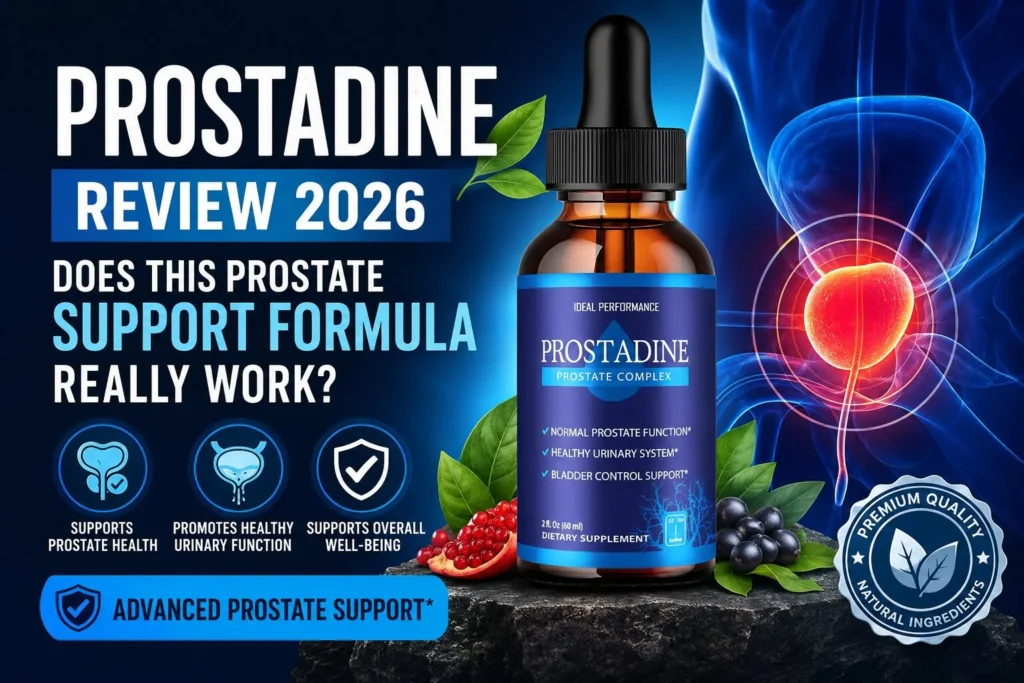
Prostadine is a liquid dietary supplement marketed primarily toward adult men, with a particular focus on supporting prostate wellness and urinary health. Unlike many prostate supplements that come in capsule or tablet form, Prostadine is delivered as a dropper-based liquid formula, which the manufacturer suggests may support absorption.
According to publicly available product information, Prostadine is formulated using a blend of plant-derived and natural ingredients — several of which are derived from seaweed and other marine sources. The product is marketed as a daily-use supplement designed to support men’s prostate health, urinary comfort, and overall men’s wellness as part of a healthy lifestyle.
Key product characteristics, as marketed:
- Format: Liquid drops (dropper bottle)
- Intended use: Prostate wellness support, urinary health support
- Target audience: Adult men, particularly those concerned about prostate health or age-related changes in urinary function
- Serving method: Taken daily, typically added to water or another beverage (verify exact instructions on current product label)
- Availability: Primarily sold through the official Prostadine website and authorized online retailers
Important clarification: Prostadine is a dietary supplement, not a prescription medication, and it has not been evaluated or approved by the U.S. Food and Drug Administration (FDA) to diagnose, treat, cure, or prevent any disease, including prostate cancer, benign prostatic hyperplasia (BPH), prostatitis, or any urinary condition. The FDA regulates dietary supplements under a different, less stringent framework than prescription drugs.
Regarding manufacturer information: Prostadine’s official website lists contact and company information, but independent verification of the full corporate background of the manufacturer at the time of this writing could not be completed to a level that would allow us to make detailed claims about the company’s history or third-party certifications. Readers are encouraged to verify current manufacturer details directly through the official Prostadine website before purchasing.
How Does Prostadine Work?
According to the manufacturer’s marketing materials, Prostadine is designed to work through a combination of its natural ingredients, which are proposed to provide antioxidant support, support healthy urinary flow, and contribute to overall prostate wellness.
The manufacturer’s general proposed mechanism includes:
- Supporting the body’s natural inflammatory response through antioxidant-rich botanical ingredients
- Providing nutrients that may play a role in men’s hormonal and glandular health
- Supporting healthy bladder function and urinary comfort
- Delivering iodine and other trace elements found in marine-derived ingredients that the manufacturer suggests may support prostate tissue health
Editorial analysis: It is important to understand the distinction between what the manufacturer proposes and what independent science has established. The marketing framework for Prostadine, like many prostate supplements, draws on ingredient-level research — studies conducted on individual ingredients in isolation rather than on the complete Prostadine formula itself.
To our knowledge at the time of this review, no independently published, peer-reviewed clinical trial specific to the complete Prostadine formula has been identified. This is not unique to Prostadine; the vast majority of dietary supplements on the market have not been subjected to the kind of rigorous, placebo-controlled clinical trials that pharmaceutical drugs are required to undergo.
This means that while some individual ingredients in Prostadine have supporting research, those findings do not automatically extend to the complete formula, the specific dosages used, or the liquid delivery format.
We return to this important distinction throughout this review.
Prostadine Ingredients
Based on publicly available product information at the time of this review, Prostadine is reported to contain the following ingredients. Note: Specific per-serving dosage amounts for each individual ingredient could not be independently verified with precision at the time of publication. We strongly encourage readers to review the current product label for complete ingredient and dosage information before use.
| Ingredient | Reported Amount | Intended Purpose | Scientific Evidence | Safety Considerations |
|---|---|---|---|---|
| Nori Yaki Extract Powder | Not independently verified | Prostate support, antioxidant | Limited; primarily animal/in vitro | Generally regarded as safe in food amounts; iodine content worth noting |
| Wakame Extract | Not independently verified | Urinary health, antioxidant | Preliminary; some anti-inflammatory data | May affect thyroid function at high iodine doses |
| Kelp Powder | Not independently verified | Iodine source, antioxidant | Some nutritional research exists | High iodine content; caution with thyroid conditions |
| Bladderwrack Powder | Not independently verified | Prostate and urinary support | Limited human clinical data | Potential thyroid and anticoagulant interactions |
| Saw Palmetto | Not independently verified | Prostate health support | Mixed; some evidence for BPH symptoms | Generally well tolerated; possible GI effects; drug interactions possible |
| Pomegranate Extract | Not independently verified | Antioxidant, prostate support | Promising early research; inconclusive for clinical outcomes | Generally safe in dietary amounts |
| Iodine | Not independently verified | Thyroid and glandular health | Well-established nutrient; role in prostate less studied | Excess iodine can be harmful; caution with thyroid conditions |
| Shilajit | Not independently verified | Energy, antioxidant | Limited clinical data; traditional use | Generally considered safe; purity and sourcing matter |
| Neem | Not independently verified | Anti-inflammatory, antioxidant | Traditional use; limited clinical evidence | Generally safe in dietary amounts; caution in pregnancy |
Table based on publicly available Prostadine marketing information. Dosages listed as “Not independently verified” because exact per-ingredient amounts could not be confirmed from third-party sources at the time of this review. Always review the current product label.
Prostadine Ingredient Analysis
Nori Yaki Extract Powder
What Is It?
Nori Yaki is a form of Japanese seaweed (a variety of Porphyra algae) that is commonly used in Asian cuisine. When processed into an extract powder, it is concentrated for use in supplement formulations.
Why Is It Included?
The manufacturer includes nori yaki extract as part of the formula’s marine-ingredient profile, proposing that it may contribute antioxidant support and provide nutrients relevant to prostate wellness.
What Does Research Say?
Research into nori yaki extract specifically for prostate health in human clinical trials is limited. More general research on red algae species suggests antioxidant and potential anti-inflammatory properties in cell-based and animal studies. Translating these findings to human prostate health outcomes requires further investigation.
What Are the Evidence Limitations?
Most available research is preclinical (cell culture or animal studies). Human clinical trials specific to nori yaki extract for prostate health could not be identified in a literature review for this article.
Safety Considerations
Nori is generally recognized as safe (GRAS) in food contexts. However, as with other seaweed-derived ingredients, iodine content is worth considering, particularly for individuals with thyroid conditions or those taking thyroid medications.
Wakame Extract
What Is It?
Wakame (Undaria pinnatifida) is a brown seaweed widely consumed in Japan and Korea. As a supplement extract, it is concentrated from the edible seaweed.
Why Is It Included?
Wakame is included in Prostadine’s formula for its proposed antioxidant, anti-inflammatory, and nutrient-delivery properties. The manufacturer suggests it may support urinary health.
What Does Research Say?
Some research has explored wakame and its component compounds (including fucoidan) for potential anti-inflammatory and antioxidant effects. Fucoidan, a polysaccharide found in wakame, has shown some preliminary anticancer and anti-inflammatory activity in laboratory settings. However, human clinical evidence specifically for prostate health outcomes remains limited and inconclusive.
What Are the Evidence Limitations?
Laboratory findings do not reliably predict human clinical outcomes. The fucoidan content in a supplement dose is not necessarily equivalent to amounts used in laboratory studies.
Safety Considerations
Wakame is generally well tolerated in food amounts. Its iodine content may be relevant for individuals managing thyroid conditions. Those on anticoagulant medications should be aware that some seaweed-derived compounds may have mild anticoagulant properties.
Kelp Powder
What Is It?
Kelp is a large brown seaweed that is one of the richest natural dietary sources of iodine.
Why Is It Included?
Kelp powder is typically included in prostate supplement formulas as a natural iodine source and antioxidant contributor. The manufacturer suggests iodine may support healthy glandular function.
What Does Research Say?
Iodine is an essential nutrient with a well-established role in thyroid function. Research into iodine’s specific role in prostate tissue health is less developed, though some researchers have explored potential associations. The evidence base does not currently support strong conclusions about kelp or iodine supplementation as a prostate health intervention.
What Are the Evidence Limitations?
The role of dietary iodine specifically in prostate health remains an area of early research. Current evidence does not support kelp as a clinically proven prostate treatment.
Safety Considerations
Excessive iodine intake can disrupt thyroid function, potentially causing hypothyroidism or hyperthyroidism in susceptible individuals. Men with existing thyroid conditions should consult their physician before using products containing multiple iodine-rich seaweed extracts.
Bladderwrack Powder
What Is It?
Bladderwrack (Fucus vesiculosus) is another brown seaweed species traditionally used in herbal medicine, particularly in European folk traditions.
Why Is It Included?
Bladderwrack is marketed as supporting prostate and urinary health, partly due to its iodine content and proposed anti-inflammatory properties.
What Does Research Say?
Available human clinical research on bladderwrack specifically for prostate health is limited. Some laboratory research has explored its potential anti-inflammatory and antioxidant effects. The NCCIH notes that evidence for bladderwrack in treating specific health conditions remains insufficient.
What Are the Evidence Limitations?
Human clinical trial data for bladderwrack as a prostate supplement is scarce. Available evidence is primarily preclinical or observational.
Safety Considerations
Bladderwrack contains iodine and may interact with thyroid medications. Some traditional preparations have been associated with heavy metal contamination depending on the seaweed’s growing environment, making sourcing quality relevant. Individuals on anticoagulant or antidiabetic medications should exercise caution and consult their physician.
Saw Palmetto
What Is It?
Saw palmetto (Serenoa repens) is one of the most extensively studied herbal ingredients marketed for men’s prostate health. It is extracted from the berries of the saw palmetto palm, native to the southeastern United States.
Why Is It Included?
Saw palmetto is included in Prostadine as one of the formula’s primary prostate-focused ingredients, based on its long history of use and research interest in supporting urinary symptoms associated with prostate enlargement.
What Does Research Say?
Saw palmetto has been the subject of numerous clinical studies, making it one of the most researched herbal ingredients in men’s health. The evidence is genuinely mixed. Earlier studies suggested some benefit for lower urinary tract symptoms (LUTS) associated with BPH. However, several large, well-designed randomized controlled trials — including the CAMUS trial published in JAMA — found that saw palmetto did not significantly outperform placebo for reducing urinary symptoms. The NCCIH currently states that evidence for saw palmetto’s effectiveness for BPH symptoms is inconsistent.
What Are the Evidence Limitations?
Results vary considerably across studies, possibly due to differences in saw palmetto extract quality, dosage, and patient populations. Current evidence does not conclusively establish saw palmetto as an effective treatment for BPH or other prostate conditions.
Safety Considerations
Saw palmetto is generally considered well tolerated. The most commonly reported side effects are mild gastrointestinal complaints. Saw palmetto may theoretically interact with anticoagulant and antiplatelet medications. Individuals scheduled for surgery should discuss use with their healthcare provider. It should not be used as a substitute for evaluation or treatment of diagnosed prostate conditions.
Pomegranate Extract
What Is It?
Pomegranate extract is derived from the fruit of Punica granatum, concentrated for its polyphenol content, particularly ellagitannins and punicalagins.
Why Is It Included?
Pomegranate extract is included in Prostadine for its antioxidant properties and emerging research interest in men’s prostate health.
What Does Research Say?
Some preliminary research has explored pomegranate extract in the context of prostate health, including studies looking at PSA doubling time in men with prostate cancer. Results have been interesting but not conclusive, and the FDA has sent warning letters to pomegranate product marketers for making unsubstantiated health claims. Pomegranate’s antioxidant properties are well documented, though translating those properties into specific prostate health outcomes requires further clinical investigation.
What Are the Evidence Limitations?
Existing prostate-related studies on pomegranate are often small, short-term, or conducted in men with specific prostate cancer diagnoses — a context that may not apply to general prostate wellness. More large-scale clinical trials are needed.
Safety Considerations
Pomegranate extract is generally considered safe in food and supplement amounts. It may interact with certain medications, including statins and blood pressure medications, in a manner similar to grapefruit. Individuals on these medications should consult their physician.
Iodine
What Is It?
Iodine is an essential micronutrient required for the production of thyroid hormones. It is naturally present in seaweed, dairy, seafood, and iodized salt.
Why Is It Included?
Iodine is included in Prostadine as a named nutrient, likely reflecting the formula’s marine ingredient base and a proposed role in supporting glandular health.
What Does Research Say?
The importance of adequate iodine for thyroid function is well established by the NIH Office of Dietary Supplements. Some researchers have theorized about iodine’s potential role in breast and prostate tissue health, but this research is early-stage and does not currently support supplementation recommendations specifically for prostate health beyond established dietary reference values.
What Are the Evidence Limitations?
Specific evidence for iodine supplementation improving prostate health outcomes in men with adequate baseline iodine status is not well established in clinical literature.
Safety Considerations
Both iodine deficiency and iodine excess can disrupt thyroid function. Men with pre-existing thyroid conditions, particularly Hashimoto’s thyroiditis or Graves’ disease, should be particularly cautious with iodine-containing supplements and should consult their endocrinologist or physician before use.
Shilajit
What Is It?
Shilajit is a mineral-rich substance found in the rocks of mountain ranges including the Himalayas, formed over centuries from the decomposition of plant material. It has a long history of use in Ayurvedic medicine.
Why Is It Included?
Shilajit is marketed in Prostadine for its proposed antioxidant, energy-supporting, and general men’s wellness properties.
What Does Research Say?
Research on shilajit is in relatively early stages in Western clinical literature. Some small studies have explored its effects on testosterone levels and fatigue. Prostate-specific evidence for shilajit is not well established in peer-reviewed literature.
What Are the Evidence Limitations?
Available human clinical trials on shilajit are generally small and limited in scope. More rigorous research is needed before strong conclusions can be drawn about its role in prostate health specifically.
Safety Considerations
The safety profile of shilajit varies depending on product purity and sourcing. Raw or unprocessed shilajit may contain heavy metals or other contaminants. Reputable supplement manufacturers use purified shilajit extract. Individuals with kidney conditions or those on antihypertensive medications should use caution.
Neem
What Is It?
Neem (Azadirachta indica) is a tree native to the Indian subcontinent, with various parts of the plant used in traditional medicine and Ayurvedic practice.
Why Is It Included?
Neem is included in Prostadine’s formula for its proposed anti-inflammatory and antioxidant properties.
What Does Research Say?
Neem has demonstrated anti-inflammatory and antimicrobial properties in laboratory studies. Prostate-specific clinical evidence in humans is limited. Some preclinical research has explored neem compounds in cancer cell models, but this does not translate to human therapeutic recommendations.
What Are the Evidence Limitations?
Human clinical evidence for neem specifically supporting prostate health is insufficient to draw reliable conclusions. Most available data is from laboratory or traditional-use contexts.
Safety Considerations
Neem is generally considered safe in dietary amounts when used by healthy adults. It is not recommended during pregnancy. Very large doses have been associated with adverse effects. Individuals on medications for diabetes, blood pressure, or immunosuppression should consult their healthcare provider before use.
Prostadine Benefits
According to the manufacturer’s marketing materials, Prostadine is designed to offer the following benefits:
1. Prostate Wellness Support
According to the manufacturer: The blend of marine and botanical ingredients is proposed to contribute to a healthy prostate environment and support normal prostate size and function.
Available scientific evidence suggests: Individual ingredients such as saw palmetto have been studied for prostate-related endpoints, though results are mixed. No clinical trial specific to the complete Prostadine formula has been identified.
2. Urinary Health Support
According to the manufacturer: Prostadine is marketed to support healthy urinary flow and bladder comfort.
Available scientific evidence suggests: Some ingredients like saw palmetto have been evaluated for lower urinary tract symptoms, with inconsistent results across trials. Urinary symptoms can arise from numerous causes, and no supplement should be assumed to address all potential underlying conditions.
3. Antioxidant Support
According to the manufacturer: The marine-derived and botanical ingredients are proposed to provide antioxidant support that may benefit prostate and overall men’s health.
Available scientific evidence suggests: Several of the included ingredients (pomegranate, wakame, nori) do have demonstrated antioxidant properties in laboratory settings. Whether supplemental antioxidants from these sources produce meaningful clinical benefits for prostate health in healthy men has not been conclusively established.
4. Healthy Aging Support for Men
According to the manufacturer: Prostadine is positioned as a men’s healthy aging supplement.
Available scientific evidence suggests: The ingredients are generally recognized as nutritionally safe and some have traditional histories of use for men’s wellness. Clinical evidence specifically linking this formula to improved aging outcomes is not available.
5. Kidney and Urinary System Support
According to the manufacturer: Some marketing language suggests support for the kidney and urinary system.
Available scientific evidence suggests: No ingredients in the reported formula have been clinically established as kidney treatments. Individuals with kidney disease should consult a nephrologist before using any new supplement.
Does Prostadine Really Work?
This is the question most readers are searching for, and it deserves a direct, honest answer.
The short answer: It depends on what you mean by “work,” and the evidence base limits what can be confidently claimed.
What we know:
- Several individual ingredients in Prostadine — particularly saw palmetto, pomegranate, and various seaweed-derived compounds — have been studied in isolation for properties relevant to prostate and urinary health.
- The evidence for these individual ingredients is mixed to preliminary in the current scientific literature.
- There is no independently published, peer-reviewed clinical trial specific to the complete Prostadine formula that we could identify at the time of this review.
- Ingredient-level research does not automatically establish that the complete formula — at the specific doses used and in liquid form — will produce equivalent outcomes.
Why individual results vary:
- Men experience urinary symptoms for many different reasons, including BPH, prostatitis, overactive bladder, urinary tract infections, or other conditions. A supplement cannot uniformly address all of these causes.
- Individual physiology, diet, lifestyle, age, and the presence of underlying medical conditions all influence how any supplement may or may not affect an individual.
- Placebo effects are real and well-documented in clinical research, meaning some men may report improvements that are not necessarily caused by the supplement itself.
Bottom line on efficacy: The available evidence does not allow us to say with confidence that Prostadine will produce measurable improvements in prostate health or urinary symptoms for any given individual. Some men may notice subjective changes; others may not. Persistent or worsening urinary symptoms should be evaluated by a qualified healthcare professional, as they may indicate a condition requiring medical diagnosis and treatment.
Prostadine Pros and Cons
| Potential Pros | Potential Cons |
|---|---|
| Liquid dropper format may be easier for some men who prefer not to swallow capsules | No independently published clinical trial on the complete formula |
| Contains several researched botanical and marine ingredients | Exact per-ingredient dosages could not be independently verified |
| Some ingredients (saw palmetto, pomegranate) have existing research interest | Evidence for several ingredients is preliminary or limited to preclinical studies |
| Marketed without artificial additives (per manufacturer claims — verify on label) | High seaweed content means combined iodine load may be relevant for some men |
| Offers a refund policy (verify current terms on official website) | Primarily available online, which may be inconvenient for some buyers |
| Transparent ingredient list publicly available | Marketing language may oversell the strength of available evidence |
| May fit into a broader men’s wellness routine | Not suitable as a replacement for professional medical evaluation |
Prostadine Side Effects and Safety
Dietary supplements are not without potential risks, and Prostadine is no exception. While the ingredient profile is generally derived from food-based or traditional botanical sources, there are several safety considerations every potential user should understand.
Possible General Side Effects:
Some users of prostate supplements, including products containing saw palmetto and seaweed-derived ingredients, have reported:
- Mild gastrointestinal discomfort (nausea, upset stomach, diarrhea)
- Headaches
- Dizziness in rare cases
- Changes in bowel habits
These effects are not universal and may not be directly attributable to Prostadine specifically, but they are associated with some of its known ingredient classes.
Iodine Load Consideration:
Prostadine contains multiple seaweed-derived ingredients (nori yaki, wakame, kelp, bladderwrack) that are naturally high in iodine. The cumulative iodine content of the formula — which we could not precisely calculate due to unverified per-ingredient dosages — could be significant for:
- Men with existing thyroid conditions (hypothyroidism, hyperthyroidism, Hashimoto’s thyroiditis)
- Men taking thyroid medications (levothyroxine, methimazole, etc.)
- Men with iodine sensitivity
Medication Interactions — Important:
Several ingredients in Prostadine have theoretical or documented interaction potential:
| Ingredient | Potential Interaction |
|---|---|
| Saw palmetto | Anticoagulants (warfarin, aspirin therapy), antiplatelet medications |
| Bladderwrack / seaweed | Thyroid medications, anticoagulants, antidiabetic medications |
| Pomegranate extract | Statins, blood pressure medications (CYP3A4 interactions, similar to grapefruit) |
| Shilajit | Antihypertensives, medications cleared by kidneys |
| Neem | Antidiabetics, immunosuppressants |
Who Should Absolutely Consult a Doctor First:
- Men taking any prescription medication
- Men with diagnosed thyroid conditions
- Men with diagnosed prostate conditions
- Men with liver or kidney conditions
- Men scheduled for surgery (saw palmetto may affect bleeding)
- Men with known allergies to seaweed, palm-derived plants, or pomegranate
Important Regulatory Clarification:
Prostadine has not been approved by the FDA to diagnose, treat, cure, or prevent any disease. It is not a substitute for medical diagnosis or treatment of prostate cancer, benign prostatic hyperplasia, prostatitis, urinary tract infections, or any other condition.
Do not delay or discontinue prescribed medical treatment in favor of this or any other dietary supplement.
Who May Consider Prostadine?
Based on the manufacturer’s marketing and the ingredient profile, Prostadine appears to be primarily aimed at:
- Adult men over 40 who are proactively interested in supporting prostate wellness as part of a broader health routine
- Men who prefer liquid supplement formats over capsules or tablets
- Men interested in marine- and botanical-based wellness supplements
- Men without diagnosed prostate conditions who are looking for a general wellness supplement in the prostate support category
Prostadine is not intended for:
- Women
- Individuals under 18
- Men with diagnosed prostate or urinary conditions who have not discussed supplement use with their physician
- Men using prescription medications without medical guidance for potential interactions
How to Use Prostadine
Based on general product marketing information, Prostadine is a liquid dropper supplement intended for daily use. The manufacturer’s instructions appear to involve adding the recommended number of drops to water or another beverage and consuming it as part of a daily routine.
Important: We could not independently verify the precise current dosage instructions (exact number of drops per serving, number of servings per day) with complete confidence at the time of this review. Dosage instructions may also be updated by the manufacturer over time.
Always follow the instructions on the current product label. Do not exceed the recommended serving size. If in doubt, consult your healthcare provider for personalized guidance.
Prostadine Price
Prostadine is primarily sold through its official website. Pricing for dietary supplements in this category typically involves tiered bundle options, where multi-bottle purchases are offered at a lower per-bottle cost than single-bottle purchases.
At the time of this review, we were unable to independently verify the exact current pricing, active promotional discounts, or specific bundle details with sufficient confidence to publish specific figures.
Supplement prices and promotional offers change frequently, and publishing unverified prices could be misleading to readers.
What we can tell you:
- Prostadine is sold in single-bottle and multi-bottle bundle options, as is standard for supplements in this category
- Multi-bottle bundles are typically positioned to offer a lower per-unit cost
- A money-back guarantee is referenced in marketing materials (verify the exact terms, duration, and conditions on the official website before purchasing)
- Shipping costs and policies should be confirmed directly with the seller before completing a purchase
Recommendation: Always verify the current price, shipping terms, and refund policy directly on the official Prostadine website or through an authorized retailer before making a purchase decision. Prices and promotional offers may change without notice.
Prostadine Customer Reviews
Understanding what real customers are saying about Prostadine provides useful context, though customer reviews come with important limitations.
What publicly available customer feedback generally suggests:
From various online forums, discussion boards, and third-party review platforms (where Prostadine is discussed), the sentiment appears to be mixed, which is consistent with most prostate health supplements:
Positive themes reported by some users:
- Some men report noticing improvements in urinary comfort and nighttime urination frequency after several weeks of use
- Users who prefer liquid supplements to capsules mention the format as a positive
- Some users describe the supplement as easy to incorporate into a daily routine
Critical or neutral themes reported by some users:
- Some men report no noticeable difference after using the product
- Customers who expected rapid results report disappointment
- Some users raise questions about the relatively high price compared to other prostate supplements
- A portion of online discussion includes questions about the strength of the scientific evidence
Important disclaimers about customer reviews:
- Individual experiences do not establish typical results. Dietary supplements can affect individuals very differently.
- Manufacturer-published testimonials are selected by the company and should not be treated as independent evidence.
- Anonymous online reviews may not be verifiable and some may be incentivized or inauthentic.
- We did not invent any testimonials for this review. All statements above reflect general sentiment categories observed from publicly available discussion.
- Star ratings for Prostadine as published on the official website could not be independently verified and are therefore not cited here.
The absence of large-scale, independent customer outcome data is a limitation that applies to this and most other dietary supplements on the market.
Is Prostadine Legit or a Scam?
This is a fair and important question, and it deserves a thorough, evidence-based answer rather than an emotional one.
Based on available information, here is our balanced evaluation:
Factors that suggest legitimacy:
- Prostadine publishes an ingredient list, which allows consumers to research individual components
- The product is sold through a website that includes contact information and customer support options
- A refund policy is referenced in marketing materials, suggesting some consumer protection (verify current terms)
- The formula draws on ingredients that have genuine — if preliminary or mixed — research interest in the wellness community
- The liquid dropper format is a legitimate supplement delivery method
Factors that merit consumer caution:
- The strength of the scientific evidence for the complete formula is limited, as noted throughout this review
- Marketing language at times implies stronger clinical evidence than the ingredient-level research actually supports
- Exact per-ingredient dosages are not readily apparent from marketing materials, making independent formulation analysis difficult
- The seaweed-heavy formula’s cumulative iodine content is not prominently disclosed in marketing, which is a transparency gap worth noting
- As with many supplements in this category, online affiliate marketing means some “reviews” readers encounter may prioritize commission over accuracy
Our conclusion: Based on what can be verified, Prostadine does not appear to be an outright fraudulent product. It is a real supplement with real ingredients that have some degree of research interest. However, it is also not a clinically proven prostate treatment, and some of its marketing language overstates what the current scientific evidence supports. Consumers should approach it as a wellness supplement — not as a medical intervention — and should maintain realistic expectations.
Prostadine vs Competitors
Below is a general comparison of Prostadine with two well-known competitors in the prostate health supplement space. Note that competitor information is based on publicly available data and may have changed since publication. Always verify current product details directly with each company.
| Feature | Prostadine | ProstaGenix | Super Beta Prostate |
|---|---|---|---|
| Intended Use | Prostate wellness, urinary health | Prostate health support | Prostate and urinary health |
| Key Ingredients | Saw palmetto, seaweed extracts, pomegranate, shilajit, neem | Beta-sitosterol, various plant sterols | Beta-sitosterol, vitamin D, zinc |
| Format | Liquid drops | Capsules | Tablets / Softgels |
| Price Range | Verify on official site | Approximately $40–$90+ per bottle depending on size | Approximately $30–$60+ depending on retailer and size |
| Return Policy | Refund policy referenced (verify current terms) | Verify on official site | Verify on official site |
| Clinical Evidence for Formula | No product-specific trial identified | No product-specific trial identified | Beta-sitosterol has broader evidence base for BPH symptoms |
| Primary Differentiator | Liquid format; marine-ingredient focus | High beta-sitosterol dose emphasis | Beta-sitosterol focus; wide retail availability |
Note: This table is for general comparison purposes. Prices are approximate ranges based on available information and may not reflect current pricing. Individual product formulations may change. This comparison does not constitute an endorsement of any competitor product.
Who Should Avoid Prostadine or Speak With a Doctor?
Certain individuals should not begin using Prostadine or any prostate supplement without first speaking to a licensed healthcare professional. This section is intended for educational purposes.
Speak with your doctor before using Prostadine if you:
- Are experiencing persistent urinary symptoms, including difficulty starting urination, weak urinary stream, or incomplete bladder emptying
- Have frequent nighttime urination (nocturia) that is disrupting your sleep
- Experience painful or burning urination
- Notice blood in your urine (hematuria) or blood in your semen — these symptoms require prompt medical evaluation
- Are currently taking any prescription medications, particularly blood thinners, thyroid medications, antihypertensives, statins, antidiabetics, or immunosuppressants
- Have a diagnosed prostate condition, including BPH, prostatitis, or prostate cancer
- Have a personal or family history of prostate cancer
- Have an existing thyroid condition
- Have liver or kidney disease
- Have known allergies to seaweed, saw palmetto, pomegranate, neem, or other listed ingredients
- Are scheduled for surgery in the near future
Critical safety reminder: Symptoms such as blood in urine, significant difficulty urinating, or acute urinary retention are medical emergencies or near-emergencies. Do not attempt to manage these symptoms with a dietary supplement. Seek immediate medical attention.
Frequently Asked Questions
1. What is Prostadine?
Prostadine is a liquid dietary supplement marketed primarily for men’s prostate wellness and urinary health support. It is not a prescription medication and has not been approved by the FDA to treat or prevent any disease.
2. What are the ingredients in Prostadine?
Based on publicly available information, Prostadine contains a blend of marine-derived and botanical ingredients including nori yaki extract powder, wakame extract, kelp powder, bladderwrack powder, saw palmetto, pomegranate extract, iodine, shilajit, and neem. Always review the current product label for the complete and most accurate ingredient list.
3. Does Prostadine really work?
The available evidence is mixed. Some individual ingredients have been studied in the context of prostate health, with inconsistent results. No independent clinical trial on the complete Prostadine formula has been identified. Individual results will vary, and the product should not be expected to work the same way for every person.
4. What are the benefits of Prostadine?
According to the manufacturer, Prostadine may support prostate wellness, healthy urinary flow, antioxidant activity, and men’s general wellness. These are marketing claims, and the scientific evidence for each claim at the formula level is limited.
5. What are Prostadine side effects?
Possible side effects associated with its ingredient classes include gastrointestinal discomfort, headaches, and potential thyroid effects from high cumulative iodine content (from multiple seaweed ingredients). Drug interactions are also possible. Consult your healthcare provider before use.
6. Is Prostadine safe?
It is not accurate to say any supplement is “100% safe” or “has no side effects.” Prostadine contains ingredients generally recognized as safe in food amounts, but cumulative iodine content and potential drug interactions mean safety is not universal. Individuals with thyroid conditions, those on prescription medications, or those with prostate conditions should consult a physician before use.
7. How do you use Prostadine?
Prostadine is a liquid supplement taken by dropper, typically added to water daily. For the most current and accurate usage instructions, refer to the product label or the official Prostadine website.
8. How much does Prostadine cost?
Pricing could not be independently verified at the time of publication with sufficient accuracy to cite specific figures. Please check the official Prostadine website for current pricing, bundle options, and any available promotions.
9. Where can I buy Prostadine?
Prostadine appears to be sold primarily through the official Prostadine website. Verify current availability before purchasing to avoid third-party counterfeits or unauthorized sellers.
10. Is Prostadine legitimate?
Based on available information, Prostadine appears to be a real product with genuine ingredients. It is not a clinically proven prostate treatment, and some marketing claims exceed what the available scientific evidence supports. Approaching it as a wellness supplement rather than a medical treatment is the most balanced perspective.
11. Is Prostadine a scam?
We found no conclusive evidence that Prostadine is a deliberately fraudulent product. However, as with many supplements in this category, marketing claims should be evaluated critically. Verify the refund policy before purchasing and maintain realistic expectations.
12. How long does Prostadine take to work?
The manufacturer suggests consistent daily use over a period of weeks to months may be needed before results, if any, are noticed. Individual variation is significant. This is common across supplement categories and is not specific to Prostadine.
13. Can Prostadine support prostate health?
Some of its individual ingredients have been studied in the context of prostate wellness. Whether the complete Prostadine formula produces meaningful prostate health outcomes has not been established through independent clinical research.
14. Can Prostadine replace medical treatment?
No. Prostadine is a dietary supplement and should never be used as a replacement for professional medical diagnosis or treatment of prostate conditions, urinary symptoms, or any other health condition. Consult a qualified healthcare provider for any medical concerns.
15. Should I talk to a doctor before using Prostadine?
Yes. This is particularly important if you take prescription medications, have existing health conditions, have prostate-related symptoms, or have a history of prostate problems. A healthcare professional can help you determine whether a prostate supplement is appropriate for your individual situation.